
The Garden Ripens All at Once. Harvest Right's $1,695 Freeze Dryer.
Verdict $1,695 buys about 416 pounds a year at a realistic pace — not the 1,800 the company advertises.
Prices are US list prices at the time of publication. Shipping, duties and local taxes vary by country — check with the manufacturer before ordering.
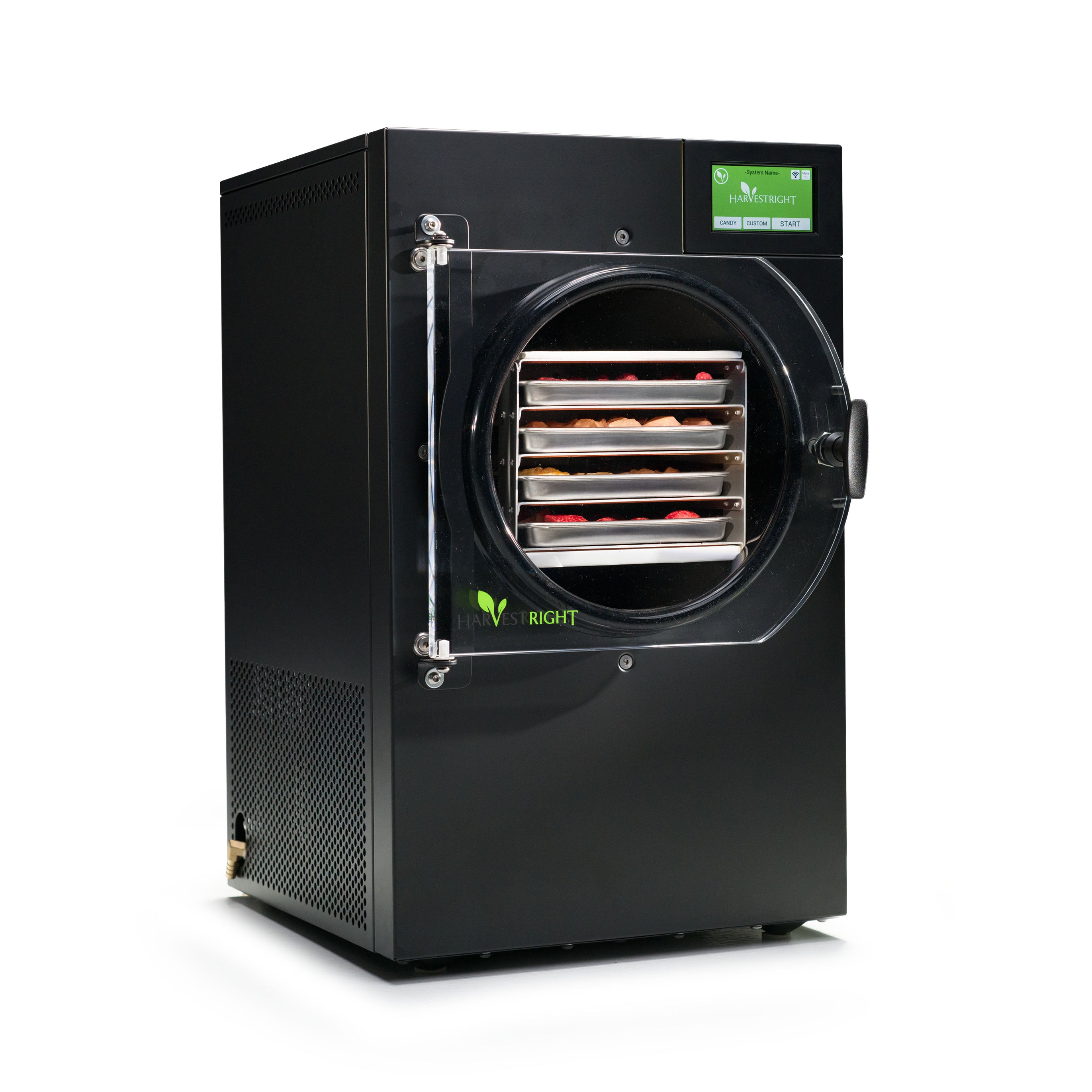
Harvest Right’s smallest freeze dryer sells for $1,695, and the company says it preserves up to 1,800 pounds of fresh food a year. The same page says it holds 6 to 10 pounds per batch. Divide: 1,800 pounds is 180 batches at maximum load, 225 at mid-range. Their own FAQ puts most food at 13 to 35 hours a batch. At the midpoints that is 5,400 hours of running — two days out of every three, all year.
The Machine
A Harvest Right home freeze dryer is a vacuum chamber with a refrigeration coil and an industrial vacuum pump bolted to the side. Food goes in on stainless trays. The chamber freezes it hard, the pump drops the pressure, and the ice turns straight to vapour without ever becoming water. What comes out is dry, light, and still the shape it went in.
Four sizes, all sold direct with a cart. The Small runs $1,695 on sale against a $2,495 list price, the Medium $2,395, the Large $2,995, the X-Large $4,995. Stainless finishes cost several hundred more, and all four were in stock.
The Small takes 4 trays and 434 square inches of tray space, weighs 91 pounds, and runs on a standard 110-volt outlet at 9 to 11 amps. The box includes the pump, oil, a filter, mylar bags, oxygen absorbers and an impulse sealer. Warranty is three years — which, at the pace Harvest Right advertises, covers about 675 batches.
The Numbers
Two sets of numbers exist for this machine: the manufacturer’s, and Utah State University Extension’s, whose food-preservation faculty published a buyer’s guide with their own measured capacities. They do not agree. (The university’s price column is older than the store’s; read it as context, not as a competing quote. The capacity and timing rows are measurements.)
| Metric | Harvest Right | Utah State Extension | Source |
|---|---|---|---|
| Small unit, price | $1,695 (list $2,495) | $1,995 | Harvest Right / USU |
| Fresh food per batch, Small | 6–10 lb | 4–7 lb | Both |
| Fresh food per batch, Medium | 10–15 lb | 7–10 lb | Both |
| Fresh food per batch, Large | 18–27 lb | 12–16 lb | Both |
| Batch time, most foods | 13–35 h | 20–40 h | Both |
| Electricity per batch | $1.25–$2.80 | $2–$5 | Harvest Right / USU |
| Claimed annual throughput, Small | up to 1,800 lb | — | Harvest Right |
| Batches to reach 1,800 lb | 180 at max load | 327 at mid-range | Our math |
| Run hours for those batches | 4,320–5,400 | ~9,810 | Our math |
| Hours in a year | 8,760 | 8,760 | Calendar |
| Safe storage, home-dried | “up to 25 years” | “not recommended beyond 5–10 years” | Harvest Right / USU, Jan 2026 |
| Noise | DATA NOT AVAILABLE FROM SOURCE | 62–67 dB | USU |
| Finished food out per batch | DATA NOT AVAILABLE FROM SOURCE | DATA NOT AVAILABLE FROM SOURCE | Both |
| Pump oil change interval | every 4–5 batches (standard), 20–30 (premier) | oil from $20/gal | Harvest Right / USU |
| Freeze-dried strawberries, bought | $27.99 / 6.4 oz = $4.37/oz | — | Augason Farms |
| Freeze-dried blueberries, bought | $70.99 / 12 oz = $5.92/oz | — | Augason Farms |
| 23-quart pressure canner | $185.99 | — | Presto |
The arithmetic, in the open. Take Harvest Right’s own mid-range figures for the Small: 8 pounds a batch, 24 hours a batch. Reaching 1,800 pounds needs 225 batches and 5,400 hours, which is 62% of the calendar. Electricity alone, at their own $1.25 to $2.80, runs $281 to $630 a year.
Now run the same 1,800 pounds through Utah State’s measured numbers — 5.5 pounds a batch, 30 hours a batch. That is 327 batches and 9,810 hours. The year has 8,760. The claim overruns the calendar by about 44 days.
What Breaks
The annual number is a ceiling, not a plan. Nobody loads a freeze dryer 225 times a year. Between batches there is pre-freezing, unloading, defrosting and sealing bags. At one batch a week — a realistic homestead pace — the Small does about 416 pounds a year, not 1,800.
“Up to 25 years” is the manufacturer’s number, and the university does not sign it. USU Extension’s January 2026 guide says freeze-dried food can be stable for 10 to 15 years and sometimes 25 — then says plainly that “consuming home-freeze-dried products is not recommended beyond 5–10 years.” Commercial cans are sealed and tested under conditions a garage does not reproduce. Buying a 25-year pantry? Run it on 5 to 10.
Whole categories of food do not go in. The same guide: “Raw meats, other animal products, and oily foods often do not freeze-dry well and can pose food safety risks.” Fat fails because it does not freeze like water. Sugar holds moisture and resists drying — which is why the pineapple in USU’s testing took 48 to 52 hours. And freeze-drying “does not kill bacteria”: meat and eggs must be cooked before they go in or after they come out.
The consumable nobody prices in. The standard oil pump needs its oil changed every 4 to 5 batches — at the advertised 225 batches a year, 50 oil changes. The premier pump stretches it to 20–30 batches, about 9 a year. The oil-free upgrade removes the job and costs $1,600, close to the price of the machine.
It is a 91-pound appliance that runs for a day and a half at 62 to 67 decibels, near the volume of a vacuum cleaner, and USU notes the units want 45°F to 80°F ambient. An unheated garage in January is outside that window.
And the number that would settle the argument is not published. Harvest Right tells you how many pounds go in. Neither it nor the university publishes how many ounces come out. Yield is the entire economics here — it is what turns a $2 batch into ounces you can hold against $4.37 store-bought — and it is DATA NOT AVAILABLE FROM SOURCE.
Who Should Buy This
The grower whose harvest arrives in one week. A garden, an orchard or a hunting season produces more than a freezer holds, on a schedule you do not control. A canner handles that too, at $185.99 — one-ninth the price. What the freeze dryer buys is food that keeps without refrigeration, weighs almost nothing, and comes back as fruit rather than jam.
The small operator selling finished product. The touchscreen has a Candy preset on it for a reason. If you are turning $2 of raw material into a bag that sells for more, this is production equipment, the payback is a margin calculation, and 225 batches a year stops sounding absurd.
Anyone whose real comparison is the can. Freeze-dried strawberries run $4.37 an ounce at Augason Farms and blueberries $5.92 — $69.98 and $94.65 a pound. $1,695 buys the Small, or 60 cans of strawberries: 24 pounds of finished food. Both cans were on backorder when we priced them, which is its own argument for owning the machine. Whether yours beats them turns on a yield nobody publishes, so measure your first three batches.
Not for: the buyer trying to beat jars on price, who will not. Not for a 25-year pantry built on a claim the extension service walks back to 5–10 years. Not for an unheated garage, a shared wall, or a household that will run it four times and let it sit.
The Stack
This issue contains affiliate links. If you buy through one, Wild Tech earns a commission at no extra cost to you. Verdicts are never for sale.
If your problem is a harvest that arrives faster than you can eat it, the Harvest Right Small at $1,695 is the entry point: 4 trays, 6 to 10 pounds a batch by the maker’s numbers and 4 to 7 by Utah State’s, 110 volts, three years of warranty, $1.25 to $2.80 of electricity per run.
Step up to the Medium at $2,395 only if you will fill it. It takes 10 to 15 pounds instead of 6 to 10 for $700 more — worth it at a batch a week, wasted at a batch a month.
Before buying, read Utah State Extension’s buyer’s guide and its January 2026 guide to what can and cannot be freeze-dried. Both are free, both are written by people with no machines to sell, and together they will tell you whether the food you actually grow belongs in a vacuum chamber.
And if the answer is a hundred pounds a year rather than a thousand, price the Presto 23-quart canner at $185.99 first. Seven quarts a load, and no pump to oil.
We earn nothing on any of these links. That is why the number above is 5,400 hours and not a slogan.
One machine. All the numbers.
Mondays and Thursdays in your inbox. Free, no spam.