
Lasers Only's CW 3000W Laser Cleaner: $4,000 for the Same 50 m²/Hour
Verdict $14,499 buys 50% more watts than the $10,499 CW 2000W SUP and the same published ceiling, 50 m²/hour. The $4,000 step buys a 380-volt three-phase supply no US utility lists as a standard service.
Prices are US list prices at the time of publication. Shipping, duties and local taxes vary by country — check with the manufacturer before ordering.
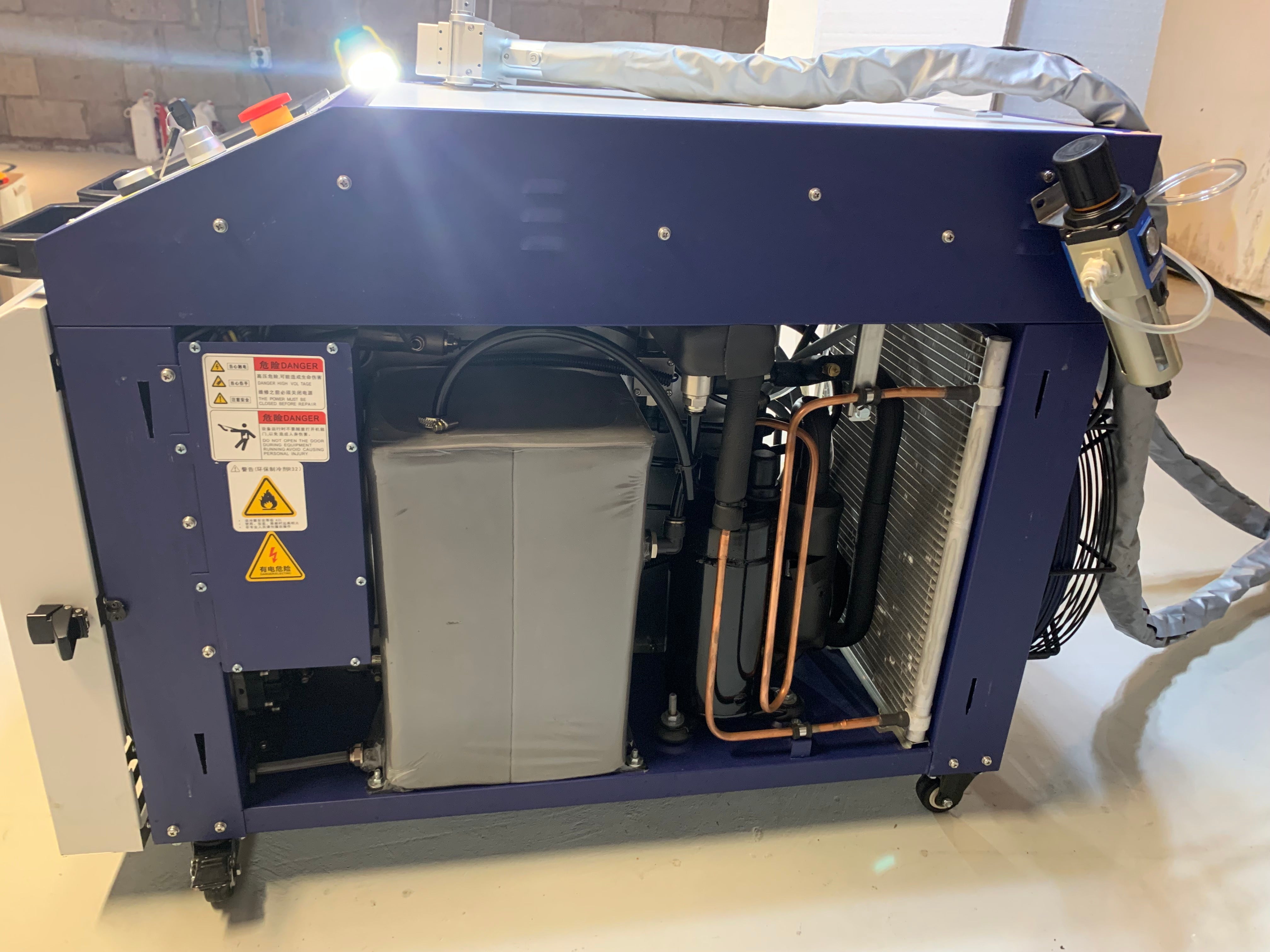
Lasers Only sells the CW 3000W SUP fiber laser cleaner for $14,499. The CW 2000W SUP, same seller, same page layout, is $10,499.
Both spec tables publish the same production figure: Clean Speed ≤ 50 m²/hour. So $4,000 — 38.1% more — buys 1.5 times the watts and, by the data sheet of the company taking the money, no additional square metres an hour.
The Machine
A Raycus RFL-C3000S-CE source, an SUP22C hand gun, a chiller inside the cabinet, 66 feet of fiber. 1080 nm, beam width to 300 mm, scan speed to 7,000 mm/s, two-year limited warranty.
Stock is real, read in raw HTML: InStock, "price":"14499.00", available: true, and a buy button with no disabled.
Three rows change between the two tables, and only three: power 2,000 to 3,000 W, fiber 33 to 66 feet, supply single-phase 220 V to three-phase 380 V. Clean Speed, Beam Width and Scan Speed are identical strings on both.
Inside the cabinet the step is real. Raycus publishes its module at under 28 kg on the 2000 and under 55 kg on the 3000 — 1.96 times — and the bigger table carries a row the smaller one never prints: maximum power consumption 10,000 W, 3.33 times the output it is rated to deliver.
The Numbers
| Line | Figure | Source |
|---|---|---|
| CW 3000W SUP | $14,499.00 | Lasers Only |
| CW 2000W SUP | $10,499.00 | Lasers Only |
| The step | $4,000.00, or 38.1% | Our math |
| Clean Speed, both machines | ≤ 50 m²/hour | Both spec tables |
| Fiber cable | 66 ft vs 33 ft | Both spec tables |
| Supply | 3-phase 380 V vs 1-phase 220 V | Both spec tables |
| Max power consumption, 3000 W | 10,000 W | Raycus table |
| Dollars per rated watt | $4.83 vs $5.25 | Our math |
| Dollars per m²/hour of published ceiling | $289.98 vs $209.98 | Our math |
| CW 6000W Handheld | $28,499.00 | Lasers Only |
| Clean Speed, 6000 W | DATA NOT AVAILABLE FROM SOURCE | Lasers Only |
Per watt, the expensive machine is the cheaper one: $4.83 against $5.25. If watts are what you are buying, the step is not a markup.
Per square metre an hour of that published ceiling it inverts: $289.98 against $209.98, $80 more for the same printed bound. Which number is honest depends on whether 3,000 watts clean faster than 2,000, and that is the figure the seller does not publish.
The rung above extends it. The CW 6000W Handheld is $28,499, $14,000 past this machine, and has no Clean Speed row at all. Its only production figure is a bullet — “Cleans Up to 1 m² Per Minute”, or 60 m²/hour, 1.2 times the table figure both cheaper machines print. It is the asymmetry the Talos T60X report found between rated acres and a brochure: a line nobody has to stand behind.
What Breaks
The expensive machine’s page is still describing the cheap one. Its Product Overview sells “standard power requirements - single phase 220V” and “the 33-foot-long fiber optics cable” while its own spec table, two tabs across, says 3-Phase 380V and 66 feet. Nine of its twelve gallery images are files also served on the $10,499 listing, and the photograph of the open front panel shows a Raycus module whose case reads RFL-C2000. None of that proves the 50 m²/hour wrong. It does mean the figure cannot be read as a measurement of this machine — and neither the Raycus table nor the SUP22C table below it carries a cleaning rate at all. DATA NOT AVAILABLE FROM SOURCE.
380 volts is not an American service voltage. PPL Electric’s Rule 2, filed in Pennsylvania, lists standard three-phase secondary service at 208Y and 480Y; 240 and 480 delta are “Special Permission Only”. SDG&E’s Rule 2, filed in California, lists utilization voltages of 120, 208, 240, 277 and 480 under ANSI C84.1. There is no 380 on either list. This machine ships free inside the US, and the words transformer and converter appear nowhere on its page. What that conversion costs is DATA NOT AVAILABLE FROM SOURCE — the first quote to get in writing.
The gun is sold at its own published ceiling. The SUP22C table, identical on both listings, reads “Applicable Power < 3000W”. The same head sits in front of both sources; on the expensive machine it arrives at the number its own row says to stay under.
What the price leaves out has not changed since the smaller machine. Goggles are $69 and a ten-pack of protective lenses $70 here, so honest entry is $14,638. A fume extractor is still not sold, no surface-roughness figure is published, and the cabinet’s net weight is in no table: the product endpoint declares 220 kg for the 2000 and the 3000 alike.
Who Should Buy This
The buyer sizing the step between two machines, who can say which spec the step is for. If the answer is watts, the dollars-per-watt line is in your favour. If it is throughput, nothing here supports it, and the 2,000-watt machine already priced against hired blasting is the one with the arithmetic attached.
The shop that already has three-phase service and a quote to step it down. Not the shop that assumes its panel will do. Price the transformer before the machine: it is the one cost nobody here has published.
Not for a 220 V single-phase shop — which is what the cheaper machine is built for, and what this one’s overview text still advertises. Not for anyone buying 3,000 watts to clean faster: the only rate either page publishes is the one the cheaper machine already has.
The Stack
No affiliate links in this issue. When a link earns us a commission, we always say so. Verdicts are never for sale.
Price the rungs on one screen first. The CW 2000W SUP at $10,499 is single-phase 220 V, 33 feet of fiber, and carries the identical Clean Speed line; the CW 1500W SUP at $8,199 is the rung below it, cart live today.
Budget the EP-8-6 glasses at $69 as part of the machine: OD 5+ across 800–1700 nm, which covers the 1080 nm this thing emits.
The protective lens ten-pack is $70, $7 a lens and the only consumable here with a published price. How fast a 3,000-watt beam eats them is not, so log it from week one.
Three rows change on a $4,000 step, and the one a buyer would pay for is not among them.
One machine. All the numbers.
Mondays and Thursdays in your inbox. Free, no spam.