
Wood-Mizer's LX30 Portable Sawmill — and Its 22-Inch Ceiling
Verdict $2,995 breaks even at 5,445 board feet of custom sawing at $0.55. Below that, paying the sawyer is cheaper.
Prices are US list prices at the time of publication. Shipping, duties and local taxes vary by country — check with the manufacturer before ordering.
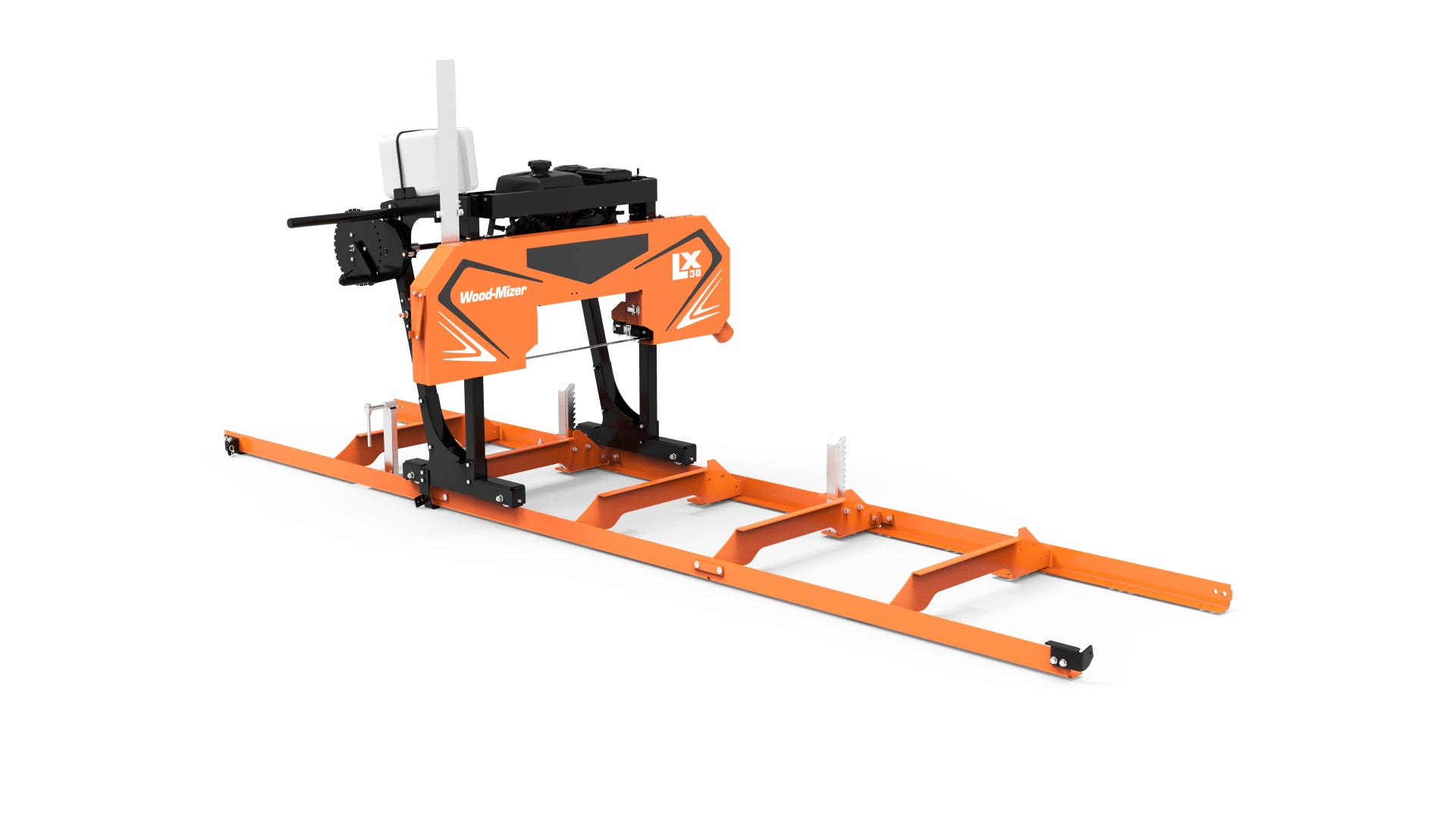
Two custom sawyers, one in Washington and one in Michigan, publish the same price for turning your log into lumber: about half a dollar a board foot. Skagit Portable Sawmill charges $0.55 for anything 2 inches and thicker. Crosscut Lumber charges $0.50 minimum. Wood-Mizer sells the machine that does the job for $2,995 — which is 5,445 board feet of somebody else’s rate, and about 39 hours at the mill at the speed Wood-Mizer itself advertises.
The Machine
The LX30 is a band sawmill: a 126-inch blade on two 15⅜-inch wheels, carried on a head you push down a steel bed while the log lies still. A 9.5 HP gas engine drives it, and Wood-Mizer sells it direct, with a cart.
It takes a log up to 22 inches across and 10 feet 10 inches long, weighing up to 1,200 pounds. Width of cut is 21.5 inches, depth 7.4 inches. Four-foot bed extensions cost $259 each if your logs are longer.
Price is $2,995 against a $3,195 list, plus $195 shipping or free pickup at 15 locations. Two-year warranty, 30 days to send it back. Blades start at $19.97 each. The mill assembles in a few hours and cuts up to 140 board feet per hour.
The Numbers
The comparison is what a working sawyer charges to bring his mill to your logs. Two publish their rates in full; Wood-Mizer publishes a 2026 guide to what the trade charges.
| Metric | Hire the sawyer | Own the LX30 | Source |
|---|---|---|---|
| Sawing, per board foot | $0.55 (2”+), $0.65 (1”) | — | Skagit |
| Sawing, per board foot | $0.50 minimum | — | Crosscut |
| Show-up minimum | $100–$200 | — | Wood-Mizer |
| Travel | $1.75/mile past 10 miles | — | Skagit |
| Helper, if you don’t stack | $25/hour | you, always | Skagit |
| Blade that hits metal | $30–$75 | $19.97 | Crosscut / Wood-Mizer |
| The machine | — | $2,995 (list $3,195) | Wood-Mizer |
| Cutting speed | DATA NOT AVAILABLE FROM SOURCE | up to 140 bd ft/hr | Wood-Mizer |
| Kiln drying after sawing | $0.50–$0.70 per board foot | the same bill | Skagit |
| A 16-inch log, 16 feet long | 180 board feet | — | Virginia Coop. Extension |
| Break-even | — | 5,445 bd ft at $0.55; 5,990 at $0.50 | Our math |
The arithmetic, in the open. Divide $2,995 by Skagit’s $0.55 and the mill is paid for at 5,445 board feet. Use Crosscut’s $0.50 and it is 5,990. Virginia Cooperative Extension’s log rule table, revised in July 2025, scales a 16-inch log 16 feet long at 180 board feet on the International ¼-inch rule. So the break-even is about 30 good logs — logs this bed only takes with extensions — and, at the 140 board feet an hour Wood-Mizer advertises, 39 hours at the machine.
What Breaks
The break-even buys the steel, not the labor. The sawyer’s $0.55 includes his hydraulic mill, his blades, his fuel and his back. Yours includes none of that. The LX30 has no hydraulics: every log is rolled and clamped by hand, and every board comes off by hand. Skagit charges $25 an hour for a helper precisely because offloading is work.
“Up to 140 board feet per hour” is a ceiling, not a plan — the same kind of number as Harvest Right’s 1,800 pounds a year, which needs more hours than the calendar has. It measures blade time, not the minutes spent rolling a 1,200-pound log onto the bed.
The mill saws. It does not dry. Green lumber is not a board. Skagit’s published kiln rate is $0.50 to $0.70 per board foot, so drying those same 5,445 feet costs $2,723 to $3,812 — more than the machine. Air-drying is free and takes a year an inch.
Twenty-two inches is a hard stop. The log the timber trade prices is 16 feet long; this bed takes 10 feet 10 inches, so two extensions at $259 each are $518 before you touch a standard log. Anything wider than 22 inches goes to somebody else’s mill.
And the number that settles the running cost is not published. Blades start at $19.97, which beats the $30 to $75 a sawyer bills when he hits a nail in your tree. How many board feet a blade cuts before it stops cutting straight is DATA NOT AVAILABLE FROM SOURCE, from Wood-Mizer and from both sawyers.
Who Should Buy This
The owner whose logs are already on the ground. Storm-fall, a cleared fence line, a woodlot being thinned. The timber is sunk cost, converting it costs $0.55 a foot, and more arrives every winter.
Anyone who wants dimensions nobody sells. A 3-inch bench slab, 14-foot barn siding, oak in a thickness the yard does not stock. Same arithmetic as the plasma table that pays off at 184 one-off parts: the machine wins on the part the supplier will not make, long before it wins on volume.
The operator already paying show-up fees. A $100 to $200 minimum plus $1.75 a mile past the first ten turns three logs into a bad invoice. Owning kills the minimum, not the rate.
Not for: the one-project buyer, who should pay the $0.55 and keep the $2,995. Not for logs over 22 inches. Not for anyone without a way to move 1,200 pounds, or a year of patience while the wood dries.
The Stack
No affiliate links in this issue. When a link earns us a commission, we always say so. Verdicts are never for sale.
If the logs keep arriving, the LX30 at $2,995 is the cheapest way into a band mill from a company that publishes its prices: 22-inch logs, 140 board feet an hour claimed, two-year warranty, 30 days to change your mind. Add $259 per bed extension before you order, not after.
If they do not, price the job instead. Skagit and Crosscut publish full lists — rates, travel, blade damage — so you can cost your pile without a phone call.
Either way, read Virginia Cooperative Extension’s guide to measuring timber and logs first. It is free, written by people with no mills to sell, and it turns a log pile into the board feet both numbers are priced in.
Nobody paid for a word of this, which is why the honest answer here is 5,445 board feet before the machine is even.
One machine. All the numbers.
Mondays and Thursdays in your inbox. Free, no spam.